Canadian e-commerce sellers and small importers pricing cross-border orders, and the people who reconcile what the courier billed.
How it works
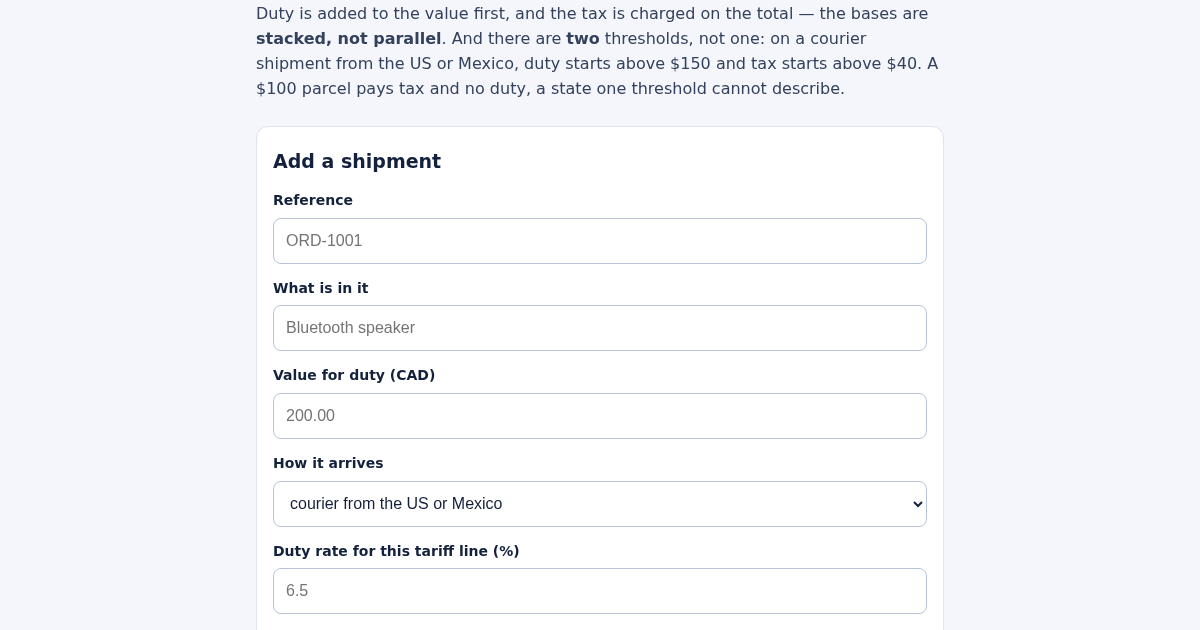
- Enter the shipment: reference, what is in it, and the value for duty.
- Say how it arrives — courier from the US or Mexico, courier from elsewhere, or postal — because that decides which thresholds apply.
- Enter the duty rate for the tariff line and the GST/HST rate for the destination province.
- Read what is collected, and how much taxing the value alone would have missed.
What you gain
- Calculates exactly which customs duty and tax a courier parcel owes based on its real value and origin, so the amount collected at the door isn't a surprise.
Screenshot
Technical details
How to set up & use
- Buy the license — your key (lic_...) appears on the order page and in your email.
- Sign in at app.synoriaai.com with your license key.
- No installation — the product runs in your browser, on your own isolated instance.
- 1. Enter your shipment reference, description, and value in the first three fields.
- 2. Choose the shipping method (courier from US/Mexico, postal, or other courier) from the dropdown.
- 3. Input the duty rate (from tariff classification) and tax rate (from province) if known; otherwise use defaults.
- 4. Click 'Add' to see the calculated total, tax amount, and the stacked-base difference.
- 5. Review the results showing duty on value, tax on value+duty, and the extra tax from stacking.
Frequently asked questions
What does this tool actually calculate?
It calculates import duty and tax for a single shipment, applying the correct thresholds (e.g., $150 duty / $40 tax for US-Mexico courier) and stacking the tax base on top of the duty amount.
Does it store my shipment data?
No. All values you enter are processed in your browser only and are not saved or transmitted to any server.
Can it handle shipments from any country?
It supports the two main scenarios: courier from US/Mexico (with dual thresholds) and all other routes (postal or courier) using the old $20 threshold for both duty and tax.
Related products

Giorni Utili: Giorni Lavorativi e Festività Italiane
Dal 2026 il 4 ottobre è festa nazionale — la Legge 8 ottobre 2025, n. 151 l'ha aggiunto all'elenco dell'articolo 2 della Legge 260/1949 — e un calendario stampato prima non ce l'ha. Nello stesso 2026 cinque delle dodici…
Giorni Utili: Giorni Lavorativi e Festività Italiane
Dal 2026 il 4 ottobre è festa nazionale — la Legge 8 ottobre 2025, n. 151 l'ha aggiunto all'elenco dell'articolo 2 della Legge 260/1949 — e un calendario stampato prima non ce l'ha. Nello stesso 2026 cinque delle dodici…
Giorni Utili: Giorni Lavorativi e Festività Italiane
Dal 2026 il 4 ottobre è festa nazionale — la Legge 8 ottobre 2025, n. 151 l'ha aggiunto all'elenco dell'articolo 2 della Legge 260/1949 — e un calendario stampato prima non ce l'ha. Nello stesso 2026 cinque delle dodici…
Giorni Utili: Giorni Lavorativi e Festività Italiane
Dal 2026 il 4 ottobre è festa nazionale — la Legge 8 ottobre 2025, n. 151 l'ha aggiunto all'elenco dell'articolo 2 della Legge 260/1949 — e un calendario stampato prima non ce l'ha. Nello stesso 2026 cinque delle dodici…